Mild hybrid as standard in the new Mazda2

You don't always have to reinvent everything. Of course, due to the legal requirements, Mazda wants to reduce the average consumption of its vehicle fleet. In the case of the Mazda2 small car, however, the manufacturer does not need a model change, but only a major update – a facelift for the second half of its life, around five years after its debut. From now on, the Mazda2 (almost) runs with mild hybrid technology as standard.
Mazda2 facelift: The most important things in brief
- Small car revised for the 2020 model year
- LED headlights and mild hybrid system as standard
- More comfort, lower consumption
- Unchanged: sleek shape, limited space
Electrification is a conservative step to reduce the CO2 average: Many competitors are aiming for larger electric car sales as quickly as possible to offset the consumption of their gasoline cars. At Mazda, the gasoline engines themselves are to become more economical instead. In larger series with the new Skyactiv-X engine technology. In the small, lightweight Mazda2, on the other hand, a new mild hybrid system is sufficient.
But first things first: From the outside, the lifted Mazda2 is recognizable by narrower headlights, a new bumper and a snappier grille. The model thus adapts to the further developed design line, which Mazda calls "Kodo". Nothing changes in the sheet metal of the Mazda2 - and thus not in the amount of space, which has always played second fiddle to the look of this model.
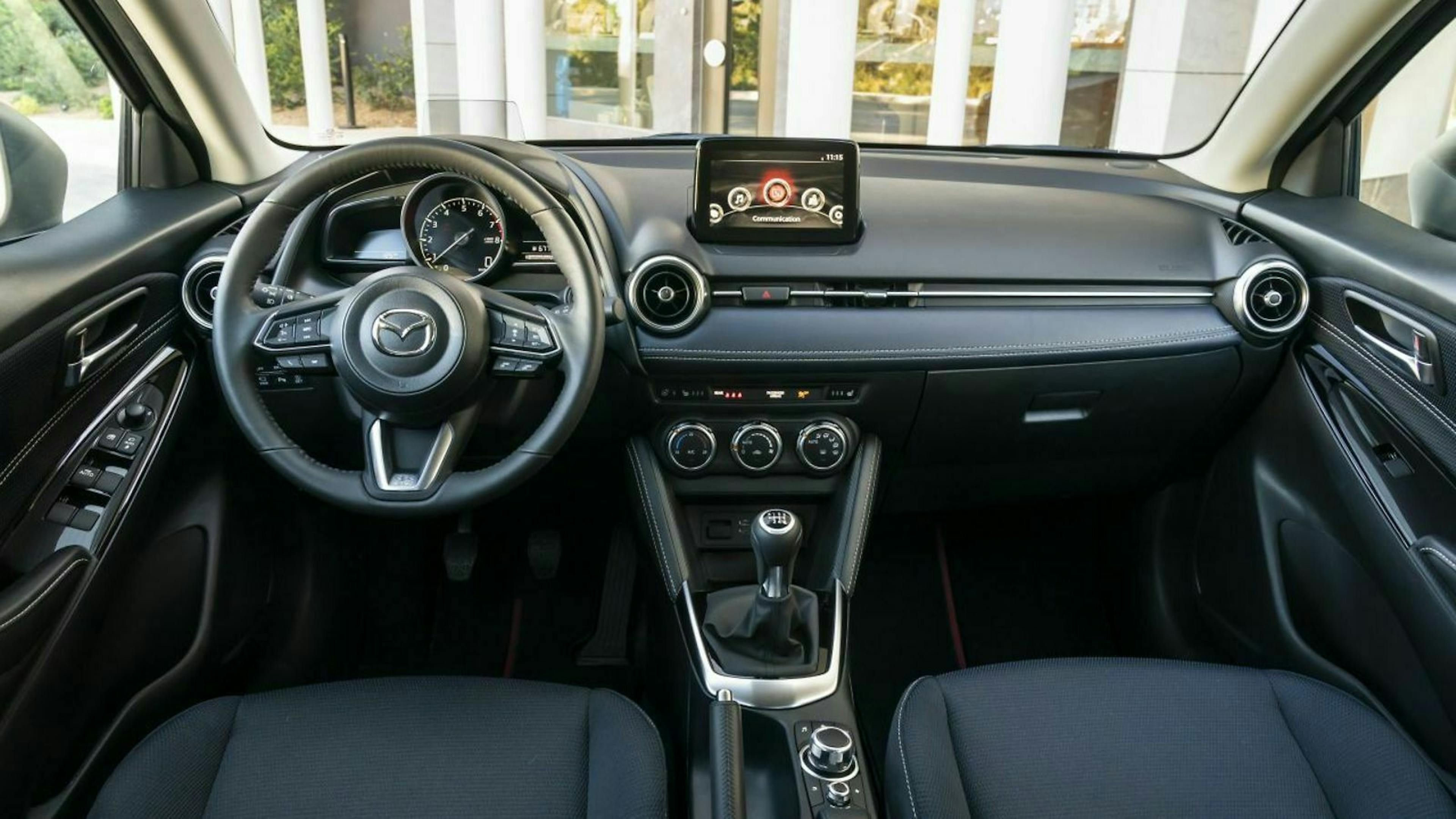
More happens under the sheet metal during the model update. According to the manufacturer, passengers experience this through improved ride comfort as well as new colors and materials in the interior. The Mazda2 also finally takes an overdue step forward in infotainment. In addition, there are now new comfort features such as an automatically dimming interior mirror and heated steering wheel. Additional insulation reduces the noise level in the interior.
Mild hybrid systems in series production
Mazda will remove the diesel from its engine portfolio as early as 2018, but it will not be back for the time being. The most powerful gasoline engine to date with 115 hp now also has to give way. What remains are two variants of the 1.5-liter gasoline engine from Mazda's Skyactiv-G series. As usual with these engines, the four-cylinder does not require turbocharging, but drives with high compression. Mazda offers two power levels with 75 hp and 90 hp. The manufacturer couples both to a manual six-speed transmission, and the more powerful one to a six-speed automatic transmission for an extra charge.
Mazda equips the manual transmissions with hybrid technology as standard. The reward: a standard consumption of 4.1 liters of gasoline per 100 km. This corresponds to CO2 emissions of 94 g/km. As expected, the automatic version is a little thirstier with 5.2 liters per 100 km (118 g/km CO2) according to NEDC.
Unlike VW, for example, Mazda does not rely on a 48-volt electrical system for the hybrid components. The system, called "Mazda M Hybrid", gets by with 22.5 volts. This reduces costs. The Japanese company is pursuing a similar principle to VW: a belt-driven starter generator complements the i-Eloop regenerative braking system, which was already on Mazda's shelf. In addition, there is a capacitor as a power storage device. This means that the system not only recovers braking energy as before. It now also supports the petrol engine with additional torque when loaded.
It also starts the engine particularly quickly and comfortably and ensures smoother gear changes. This allows Mazda to retune the automatic start-stop system. The engine is now only restarted when the driver has engaged the gear and switches from the brake to the accelerator pedal. When upshifting, the belt starter generator also adjusts the speed to the expected new ratio. This also minimizes losses and increases comfort. In addition, there are internal engine saving measures: Mazda says it has been able to reduce fuel consumption by half when the engine is cold. With modified coolant management, the engine should reach its operating temperature faster.
Chassis of the lifted Mazda2
For the chassis, Mazda relies primarily on fine-tuning springs, shock absorbers and wheel suspensions. The biggest intervention: The ESP-based "G-Vectoring" control system now brakes the wheels on the outside of the curve slightly at the exit of the curve in addition to the previous function. According to Mazda, this increases stability when exiting the curve.
Easier for the occupants to feel: New seats are intended to provide the driver and front passenger with a more body-friendly seating position. The goal of the Japanese developers: an upright pelvic position to minimize head movements. To achieve this, the engineers are relying on new seat springs and new urethane foam with better cushioning and support properties.
New features: Finally modern infotainment
Mazda has been lagging behind in infotainment for some time. Until the very end, the manufacturer is reluctant to allow Apple and Google access to its on-board systems. This is now a thing of the past, Apple CarPlay and Android Auto are now part of the equipment range. Customers can more easily pair their smartphone with the car for telephony, navigation or music streaming. The connection is via USB.
If you also want an internal navigation system, you will of course also find this in the price list. For the first time at Mazda, fee-based online services such as real-time traffic reports can be added.
New safety and lighting systems in the Mazda2
Dark country roads have to be careful. After the Opel Corsa, the Mazda2 finally brings a matrix LED lighting system to the small car segment. Static LED headlights are even standard. The Mazda system is called "ALH" and consists of 20 elements that individually control their distribution and direction. This means that the small car always illuminates the road brightly without dazzling other road users.
Many other technical systems will receive minor updates for the facelift of the Mazda2. With a new camera, the City Emergency Brake Assist now also detects pedestrians at night. The system detects other vehicles up to a speed of 80 km/h. In addition, the assistant also works when reversing. In the pre-facelift model, Emergency Brake Assist reacts only in the forward direction and up to a speed of 30 km/h. Other available assistants include Active Lane Keeping Assist, Traffic Sign Recognition (TSR) and a 360-degree monitor. For precise parking of the Mazda2 body, which is still not too clear.
Four trim levels in the Mazda2 (2020)
As usual, Mazda wants to offer four equipment lines and some packages in the small car - a quite diverse price list for a Japanese importer. From the base onwards, there is an extensive range of standard equipment. Every Mazda2 has LED headlights and radio, and mild hybrid technology is always included in the manual transmission. Air conditioning is included from the middle "center line", as well as a hands-free system and cruise control.
In addition, the manufacturer offers the "Exclusive Line" with full connectivity and some active assistants. Heated seats and parking assistance are also included. The top-of-the-range "Sports Line" equipment does not leave too much to be desired. Mazda packs some of them in additional packages for a fee: Keyless entry is included, as is the matrix LED light, traffic sign recognition, the reversing camera or the city emergency braking system in the "Plus" version. Mazda dealers love the high average prices that they can achieve even with a small car like the Mazda2.
After all, the entry-level price for the thoroughly revised Mazda2 with modified drive technology is only rising moderately: the basic version with 75 hp now costs 14,190 euros, i.e. a reasonable 800 euros more than before. The new Mazda has been at dealerships since January 31, 2020.
Technical data Mazda2 Facelift 2020
| Model | Mazda2 SKYACTIV-G 75 M Hybrid |
|---|---|
| Engine | 1.5-litre four-cylinder petrol engine |
| Achievement | 75 hp (55 kW) |
| Torque | 135 Nm max. |
| 0-100 km/h | 11.4 s |
| Velocity | 171 km/h |
| Consumption | 4.1 l/100 km |
| CO2 | 94 g/km |
| Length | 4,065 mm |
| Width | 1,695 mm |
| Height | 1,495 mm |
| Wheelbase | 2,570 mm |
| Tare | 1,144 kg |
| Trunk volume | 280-950 l |
| Base price | 14,190 euros |
| Market launch | End of January 2020 |
Posting Komentar untuk "Mild hybrid as standard in the new Mazda2"