For safety and wallet: Check the tire pressure correctly

Many drivers no longer control the air pressure in the tires. They rely on automatic control systems. Depending on the type of monitoring, however, the automatic system cannot detect a loss of pressure at all. Incorrectly inflated tyres not only mean constantly increasing fuel consumption, but also endanger the safety of the driver, passengers and other road users.
Poetry and truth about air pressure
Do you still remember the driving school? Check tire pressure at every fuel stop, but at least once a month? The tip is still relevant today. It is better to check every two weeks, but in any case before starting a long journey. You can never be sure that all the valves are in order. And even if it is, the rubber itself is never 100 percent tight. Air is a gas that can escape to the outside. As a rule of thumb, you can expect a pressure loss of 0.1 bar in three months.
Filling with nitrogen, which can be obtained for around 10 € and is recognizable by the green valve caps, does not offer any special advantages. Our air consists of 78 percent nitrogen anyway. For special applications such as motorsport or the landing gear of an aircraft, it can be important to maintain the pressure exactly or to keep oxygen away in the event of a tire fire. For normal driving, you save the money and fill up with free air from the compressor.
The vehicle manufacturer recommends the correct air pressure depending on the load of the car. So that you don't have to look for the operating instructions, there is a sticker on the vehicle, usually in the door frame of the driver's door or in the fuel filler cap. It's best to forget about special tips for winter operation right away. One driver advises increased pressure because of the cold. A 10-degree difference in the outside temperature changes the tire pressure by 0.07 bar. On the other hand, a fast motorway drive means a pressure increase of more than four times. Another rider lets off air because of the larger contact surface. Good if he has to free himself from snow and ice, bad for 99 percent of the snow-free or cleared roads.
This is how you can recognize problems with the tire pressure
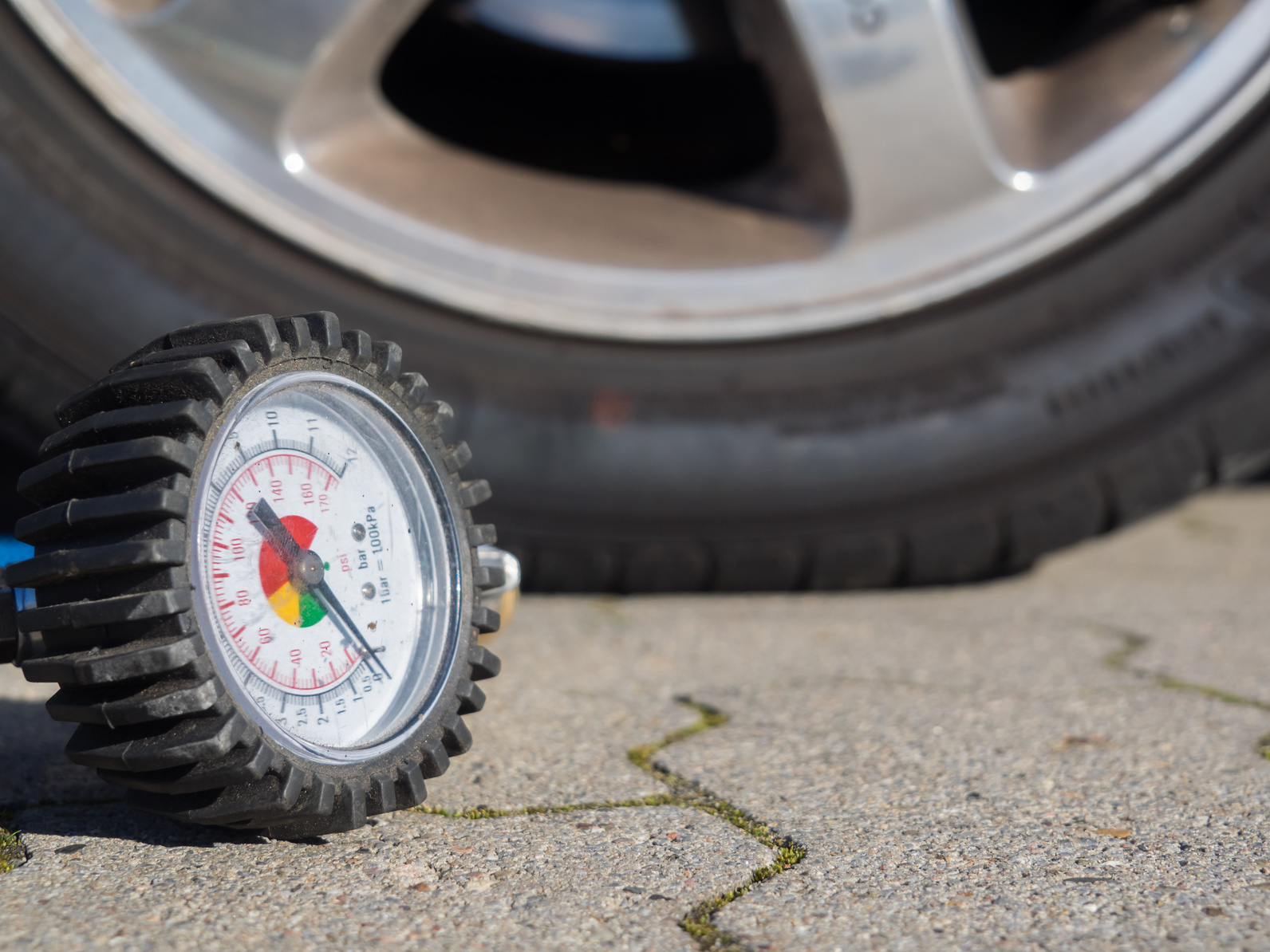
Actually, regular testing should not get to the point where you notice a loss of pressure due to the handling of your car. However, a drop in pressure can also occur suddenly, for example due to a retracted foreign body. If the car pulls to the side on a straight road, a puncture can be the cause. Measure the air pressure as soon as possible. If everything is normal, have the car checked in the workshop for other damage, for example to the steering, axles or shock absorbers. The same applies to screeching tires in the curve. This may be due to her driving style, but in any case it shows that tires are approaching the grip limit and a crash is imminent. Monitor fuel consumption. If this increases noticeably, although there is no recognizable cause such as frequent city driving, operation of the air conditioning in summer or low outside temperatures and sluggish lubrication, too low tire pressure could also be the cause.
On average, every driver only has a flat tire every five to seven years – or every 100,000 to 150,000 kilometers. But when it happens, it is annoying at best, often dangerous. Run-flat tyres keep the car ready to drive. Be sure that you will still notice the loss of pressure. A display on the dashboard warns you, and you should also reduce your speed to a maximum of 80 kilometers per hour.
How a tire pressure monitoring system works
Tire pressure monitoring systems (TPMS) have been mandatory for new vehicle types since November 2012. This has applied to all new cars since November 2014, even if the type approval is older. Only directly measuring systems make pressure testing superfluous in parts. However, these are expensive and must be available separately on summer and winter wheels.
This is why around a third of manufacturers rely on indirect TPMS. It measures the difference in speed of the four wheels. If a tire loses air, the rolling behavior and thus the number of revolutions changes, and there is an alarm. However, it quickly becomes clear from the principle of differential measurement: if the tires lose air evenly, which should be the case without damage, the indirect TPMS does not register anything. Regular pressure measurement is therefore still necessary in any case.
The right measurement at the petrol station
If you want to check the air pressure in the tires, your first trip will be to the gas station. During the first ten kilometers of driving, the tire is still cold enough to allow an undistorted measurement. At the end of a long journey, the tyre is too hot and the internal pressure is therefore increased. If you were to measure and deflate now, it would be wrong, because the manufacturer's information on the recommended pressure refers to a cold tire. If you are on your way to a business lunch or job interview, save yourself the measurement for once. Even in good weather, you will get your fingers dirty with brake dust. For all more suitable occasions, take one of the disposable gloves from the diesel pump.
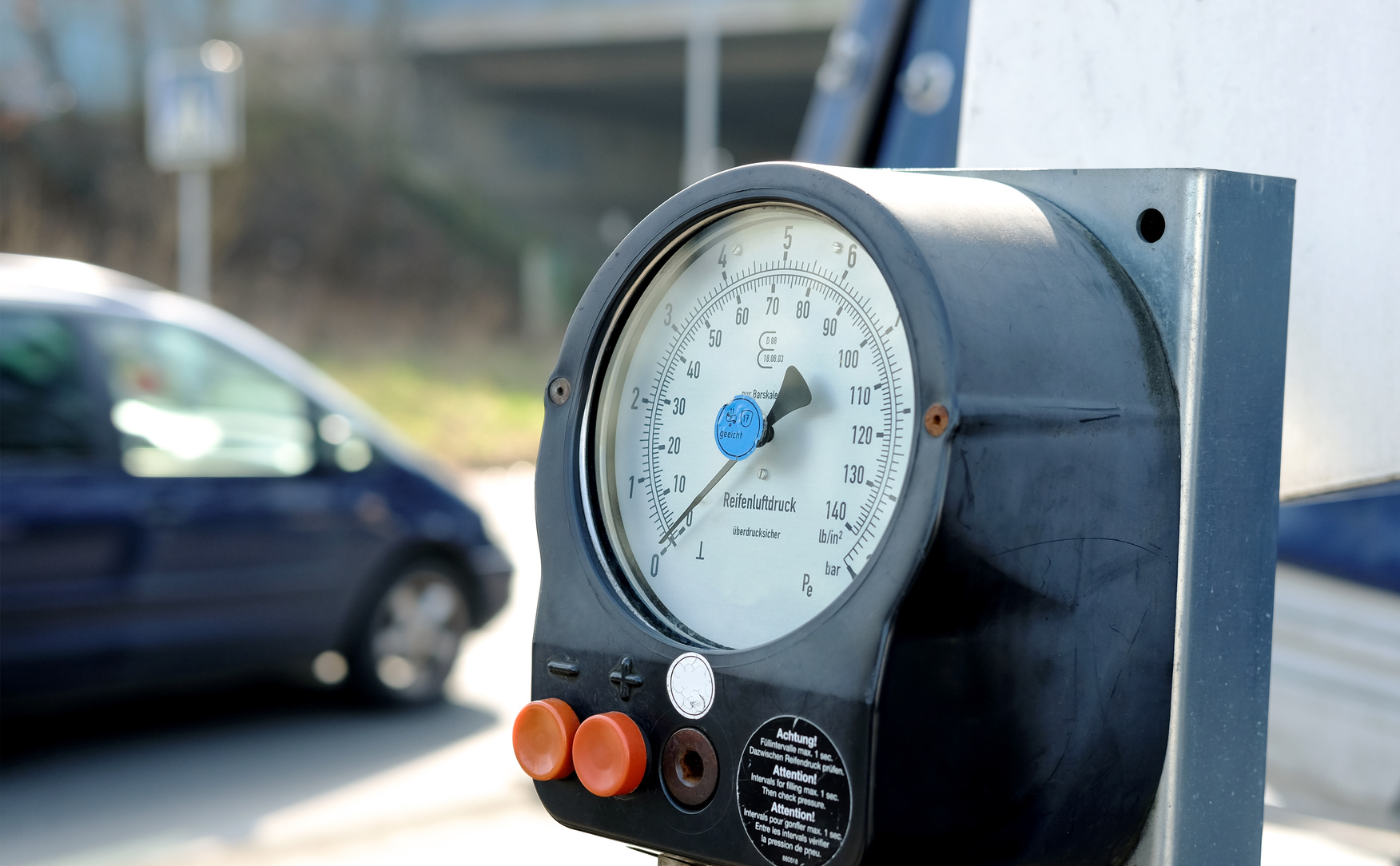
You will find one of two different systems at most petrol stations – contrary to the declarations of intent, still free of charge. With mobile compressors, you go to each tire, unscrew the valve cap, tuck it away well and place the valve attachment at the end of the tube straight on the valve without tilting. Often a clamp that is operated with the thumb supports the fastening. You can hear well whether everything is in the right place. If air escapes hissing, something is wrong. You can read the current tyre pressure, measured in bar, on the scale of the compressor. Use the (+) and (-) buttons to increase or decrease the pressure.
Press the buttons only briefly and check the result in between. The mobile device has only a limited amount of compressed air on board. If you have added air to two or three tires, it may be empty. Hang it back on the station – the filling process is also audible here. After a short time, you can check the remaining tires and fill them if necessary. After the check, don't forget to unscrew the valve cap that you hope has been found. It protects the sensitive inner workings of the valve. You must therefore replace lost caps.
Permanently installed columns on which you preselect a desired air pressure are still not very common. Park your car centrally in front of the column so that the air hose reaches all tires. Attach the valve attachment as with the mobile compressor. Pressure regulation starts automatically. Since you can't see the display on the pillar when you're crouching next to the tire, the pneumatic system beeps when the preset tire pressure is reached. In the event of an error, for example if the hose is not placed correctly, there is also an acoustic signal and an error message in the display of the column.
It doesn't hurt to admit up to 0.2 bar compared to the manufacturer's recommendation. The vehicle then feels a little harder in the suspension. If a small loss of comfort is okay for you, the lower rolling resistance will save you some fuel without damaging the tire or jeopardizing driving safety. However, it should not be more than 0.2 bar additionally, because this is at the expense of safety. Have you also thought about the spare wheel? Here you can also fill in 0.5 bar above target. This is harmless, and you can safely forget about this wheel for a year during your air pressure checks.
Trust is good, control is better: even if the summer or winter wheels come fresh from the tire hotel, check the pressure. The workshop may have made a mistake, or you may simply want the extra 0.2 bar to save fuel.
With the right pressure, it's cheaper and better to drive
In addition to a good conscience towards the environment and the joy of lower consumption, you benefit in particular from safety aspects. 0.5 bar too little is already clearly noticeable. The stability of the vehicle when cornering decreases, braking distances are noticeably longer. As the tyre is subjected to more stress, it wears out faster and eventually bursts. Only a little air decides whether a braking and evasive maneuver just works or whether people could be seriously harmed. This should be worth a short examination.
Link tips on the topic:
- https://www.kennstdueinen.de/branche-auto-motorrad-und-verkehr-2.html
- http://www.finanzen.net/nachricht/aktien/ReifenDirekt-de-bestaetigt-zunehmenden-Trend-von-Ganzjahresreifen-4924642
KennstDuEinen.de is a rating portal for service providers in all industries. Search and find the best service providers in your area!
Posting Komentar untuk "For safety and wallet: Check the tire pressure correctly"